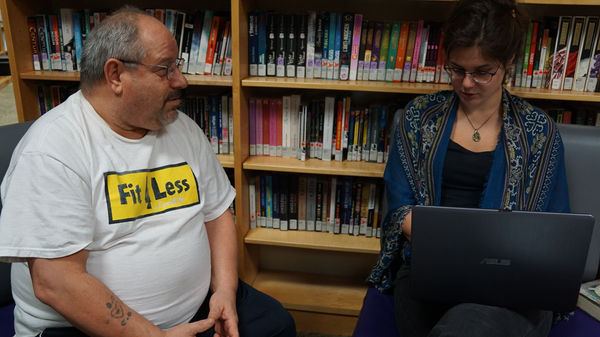
We meet at the library for a final round of editing. The text of Robert Concordia's illustrated story about his years at the Rideau Regional Centre is nearly complete. This last session is devoted to checking, fine-tuning, and making sure every word on the page says exactly what Robert wants to say — nothing more, nothing less.
The Public Library as a Meeting Place
There is something fitting about working on a survivor's story in a public library. Libraries belong to everyone. They ask for no proof of income, professional affiliation, or referral. You can sit at a table, spread out your papers, and work as long as you need. For Robert, whose early years were spent in a place that controlled access to almost everything — books, community, the outside world — the library represents a kind of ordinary freedom worth appreciating.
The Ottawa Public Library has long been a community anchor. Choosing this location for the revision session was a statement about what kind of space this story deserved. Not an institutional boardroom. Not a clinical office. A public table, in a building open to all, at the heart of a city where people live and move freely.
The Collaborative Revision Process
Revising someone else's story is a responsibility. The team working with Robert understood that their role was to support his voice, not substitute their own. This meant asking questions rather than making changes unilaterally: does this sentence say what you want it to say? Is this the word you would use? Is there something here that doesn't feel right?
This distinction matters. There is a long history of well-intentioned people speaking on behalf of people with intellectual disabilities rather than alongside them — summarizing, interpreting, softening, or expanding in ways that drift from what the person actually said. The MTE project rested on a different premise: the story belongs to the person who lived it, and the team's task is to help it reach the page with accuracy and care, not to improve it according to someone else's aesthetic standards.
Robert had been working on this story since the project's earliest sessions. He drew on his memory of specific details: the routines at the Rideau Regional Centre, the people he had met there, the moments that had stayed with him. Putting those memories into writing required returning to them again and again, comparing the words with the memory, finding the right sequence.
Why the Text Matters
The illustrated story was eventually published and made available as a teaching resource, alongside the project's other materials. It now exists as a document — something that can be handed to a student, placed in a library, shared in a classroom. Robert's account of the Rideau Regional Centre is part of the historical record of what these institutions were and what they did to the people living in them.
That permanence was part of what gave the revision sessions their weight. Getting the text right mattered because the text was going to last. The words chosen during that December session at the library are the words that were kept. The group worked with care because the work deserved that care.
At the end of the session, the text was finished. The team gathered its notes and the afternoon light came through the library windows. Something that had been in progress for months was now, in its written form, complete.