The Rideau Regional Centre for Developmental Services, located in Smiths Falls, Ontario, operated for over five decades before its closure in 2009. At its peak, the facility housed thousands of people with developmental disabilities — many of whom were placed there as children, often at the recommendation of medical professionals who saw institutionalisation as the appropriate response to disability. Understanding this history is central to the work of Memory Witness and Hope.
Institutions like Rideau Regional were not unique to Ontario or to Canada. Across North America and much of the western world, the twentieth century saw a massive expansion of residential institutions for people with intellectual and developmental disabilities. The assumptions behind this expansion — that people with disabilities were better served by separation from mainstream society, that large residential facilities could provide the care and supervision families could not — were widespread and rarely questioned in public discourse until the disability rights movement gained momentum in the 1960s and 1970s.
What survivors of Rideau Regional and similar facilities describe is a world structured around institutional logic rather than individual need. Days followed rigid schedules. Movement was restricted. Relationships outside the institution were difficult to maintain. Educational and vocational opportunities were limited or unavailable. The conditions varied over time and across different parts of the facility, but the fundamental reality of institutional life — the loss of ordinary freedoms and social connections — was consistent.
The closure of Rideau Regional in 2009 came after years of advocacy by disability rights organisations, families, and survivors themselves. The closure was welcomed as a long-overdue recognition that community living was both possible and preferable for people with developmental disabilities. But closure did not erase the history of what had happened there, and for many survivors the end of the institution brought complex feelings: relief, grief, and a persistent need to have their experiences acknowledged.
In 2013, the Ontario government issued a formal apology to survivors of institutions including Rideau Regional. The apology acknowledged the harm caused by institutionalisation and committed the government to a policy of community inclusion. For survivors, the apology was meaningful — but it was also understood as a beginning, not an ending. An apology does not automatically restore the relationships, opportunities, and years that were lost.
Memory Witness and Hope was created in part to address what apologies and policy statements cannot fully accomplish: the need for survivors to tell their own stories, in their own words, and to have those stories heard and preserved. The project draws on an understanding that bearing witness is itself a form of justice. When survivors speak about their experiences at Rideau Regional and other institutions, they are doing something that the institutional system was specifically designed to prevent — they are asserting their own authority over their own histories.
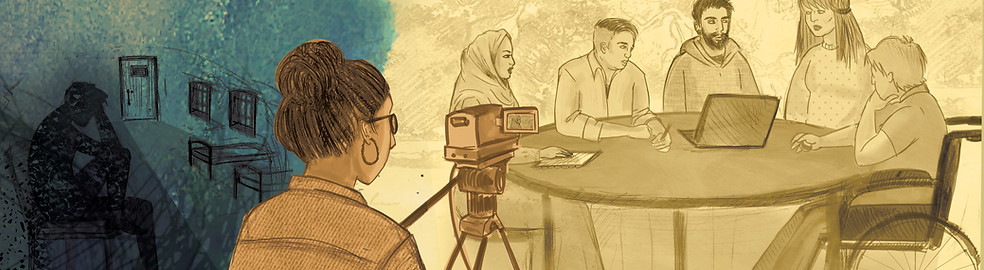
Robert Concordia's illustrated narrative, produced through the project, offers one example of what this looks like in practice. His account of life at Rideau Regional is not a clinical record or a policy document. It is a personal history, shaped by his own memory and his own sense of what mattered. That difference — between a history told by institutions and a history told by survivors — is at the heart of what MWH-MTE is trying to preserve.
The institutional past is not simply past. Its effects continue in the lives of the people who lived through it, and in the broader social attitudes toward disability that both produced and were produced by the institutional system. Understanding that history — honestly, with attention to what survivors actually experienced — remains an important part of building a more inclusive present.