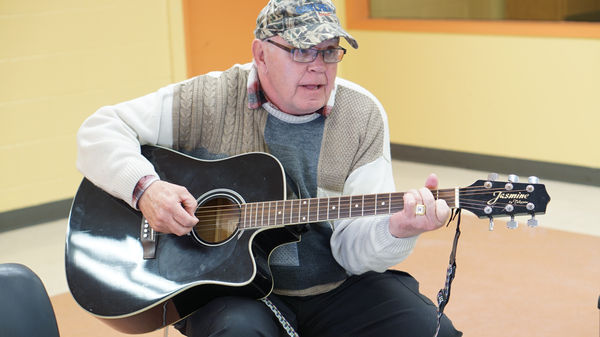
We were honoured to be joined by Rideau Regional survivor David McKillop. David is the President of People First of Ontario and an accomplished musician and public speaker. He has been working tirelessly to close institutions across Canada.
David shared his music and story with us. He encouraged us to "stand up for our rights" and tell our stories. His advice is important as we continue to work on our video.
David performed "I have suffered enough", a song he wrote about his experiences as a survivor of Rideau Regional Centre.
What music carries
Writing a song about institutional experience is a different kind of testimony than writing a report or giving a speech. Music holds emotion in a form that can be heard rather than just read, felt rather than just understood. "I have suffered enough" is a statement that arrives differently when it is sung — the voice itself carrying the weight of the words, the melody giving them a shape that persists after the performance ends.
For David McKillop, music has been a means of processing experiences that were, by any measure, extremely difficult. To have spent formative years inside Rideau Regional Centre, to have lived through what that institution was, and to have emerged from it not only intact but with the capacity to perform, advocate, and lead — that is a story worth telling in any form. The fact that David tells it through music adds a layer of generosity. He is not only bearing witness to his own experience. He is offering an experience to his audience: the chance to hear something true and to sit with it.
People First of Ontario and the fight to close institutions
People First of Ontario is a province-wide organisation run by and for people with intellectual disabilities. Its core principle is self-determination: the right of people with intellectual disabilities to speak for themselves, make their own choices, and live in the community with the supports they need. The organisation has been at the forefront of advocacy for deinstitutionalisation in Ontario, and its members have provided testimony in legal proceedings, public consultations, and legislative reviews that have shaped policy.
As the organisation's president, David McKillop represents a leadership model that the disability rights movement has long championed: people with lived experience in positions of genuine authority, driving decisions about issues that affect them directly. His visit to the MWH group was not that of an outside expert. He came as someone who had been where the participants had been, who understood what they were doing and why, and who could speak from that understanding.
What "stand up for your rights" means
David's encouragement to the group — "stand up for your rights and tell your stories" — is advice that requires unpacking for people who have experienced the institutional system. Standing up for your rights assumes that you know you have rights, that you have the confidence to assert them, and that you believe asserting them will make a difference. None of those things can be taken for granted for people whose early lives were defined by a system that denied all three.
Learning to use a camera, learning to frame your own story, gathering in a studio with others who understand your history — these are all part of what it means to stand up. David McKillop's visit reminded the group that they were part of a tradition of people who had done exactly this work, and that it was both possible and necessary.