Group art projects let us think through issues like ableism.
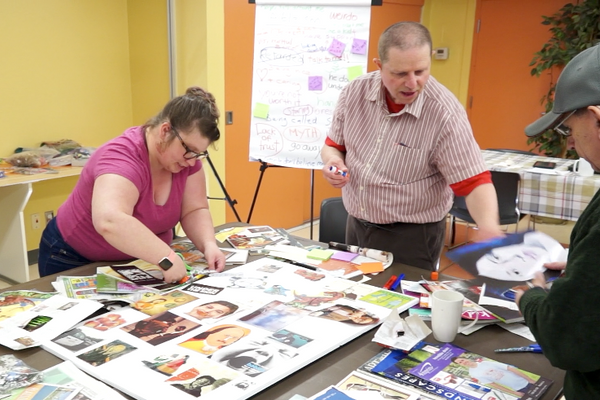
How does ableism impact people with intellectual disabilities? We brainstorm some examples. We find images and photographs that show how ableism shapes our lives. These help us express how others see us and how we see ourselves.
Our photo collage is well under way! We practise new skills with our tablets, using film and photography to represent our own lives.
Robert takes his tablet to the Canadian Tulip Festival and shares his photographs with the group.
What ableism meant in the context of Ontario's institutions
Ableism is the system of beliefs and practices that treats people with disabilities as inherently less capable, less valuable, or less worthy of full participation in society. It operates at every level — in individual attitudes, institutional structures, and policy decisions. For people with intellectual disabilities in Ontario, ableism was not an abstract concept. It was the justification for removing people from their families and communities and placing them in large residential facilities where their lives would be managed by others.
The assumption driving that system was that people with intellectual disabilities could not make their own decisions, could not live independently, could not contribute meaningfully to community life. Those assumptions were wrong, and they caused enormous harm. But they were not challenged effectively for decades, in part because the people most affected were denied the tools to challenge them. They were segregated from public life and therefore largely invisible to the general public. Their voices were not heard. Their stories were not told.
Independent Living Canada and the broader disability rights movement in this country have worked for decades to dismantle the structures that ableism built — fighting for deinstitutionalisation, accessible housing, supported decision-making, and the right of people with disabilities to live in community on their own terms. The photo collage created by the MWH group sits within that longer history of resistance.
Art as a form of resistance
Creating a collage about ableism is not just an art exercise. It is an act of naming. When participants search for images that represent how ableism shapes their lives, they are doing several things at once: they are acknowledging that ableism is real, they are exercising critical judgement about the images they encounter, and they are making choices about representation that put them in the role of author rather than subject.
The images participants found ranged from obvious to subtle — pictures of inaccessible spaces, of people with disabilities being spoken about rather than spoken with, of care settings that resemble institutions more than homes. Some images captured the smaller everyday forms of ableism: being overlooked, being underestimated, being treated as less than adult. Talking about those images together was a way of developing a shared vocabulary for experiences that had often been difficult to articulate.
The resulting collages were layered and personal. They did not arrive at a single message. They mapped the terrain of lived experience — which is complex, sometimes contradictory, and resistant to simple summary. That complexity was itself significant. The project was not interested in producing propaganda. It was interested in truth.