Memory Witness and Hope is grateful to the students and teachers at Lester B. Pearson Catholic High School in Ottawa for hosting Robert and Natalie today. Thank you for your warm welcome and thoughtful questions, and a special thanks to Mr. Milburn for creating space for survivors to share their stories.
Why these visits matter
One of the core aims of the Memory Witness and Hope project has always been to ensure that the history of Ontario's large institutions does not disappear quietly into the past. Rideau Regional Centre, Huronia Regional Centre, and others operated for decades, and tens of thousands of people passed through them. The students at Lester B. Pearson Catholic High School were born into a world where those institutions had already closed — most of them know little or nothing about what life inside looked like, or about the survivors who are still living with the effects.
School visits like this one create a direct connection between survivors and the generation that will shape policy and practice going forward. Robert and Natalie do not present statistics or abstract histories. They share what it felt like: the routines, the restrictions, the moments of loss, and the long work of rebuilding a life outside. Young people hear this differently than they read about it. It lands differently when the person telling the story is sitting in the room.
What the students asked
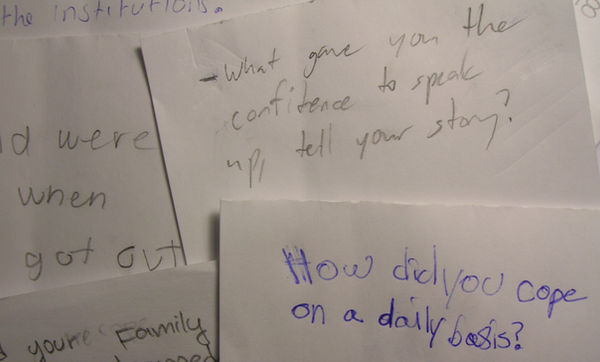
The questions and responses from students showed genuine engagement — not the polite silence of a captive audience, but the kind of curiosity that means something has been understood:
- "Why do places like this exist?"
- "It was really good talk, I enjoyed and hope we are able to shut down all the institutions."
- "What gave you the confidence to speak up, tell your story?"
- "How did you feel about being in the institution, and how do you feel now that you are out?"
- "I liked your story!"
These questions are not simple ones. "Why do places like this exist?" is a question that historians, disability rights scholars, and survivors themselves have spent careers answering. The fact that a high school student asks it directly, having just heard a survivor's account, is an indication that the work of bearing witness is having exactly the effect it should.
Education as prevention
There is a practical dimension to this outreach work beyond its immediate impact on the students in that classroom. The understanding that people with intellectual disabilities are full citizens with rights, that institutions are not a natural or inevitable response to disability, and that survivors deserve to be heard — these are not things that can be assumed. They need to be taught, and they need to be taught by people who know them from experience, not only from textbooks.
Robert and Natalie carry something into a classroom that no curriculum can replicate: the authority of lived experience. The students at Lester B. Pearson Catholic High School are fortunate to have heard that story. Many of them will carry it forward. People First of Canada and its provincial chapters have long understood that disability rights education at the community level is as important as any formal advocacy — and visits like this one are a central part of that work.
Thank you to Lester B. Pearson Catholic High School for opening those doors.